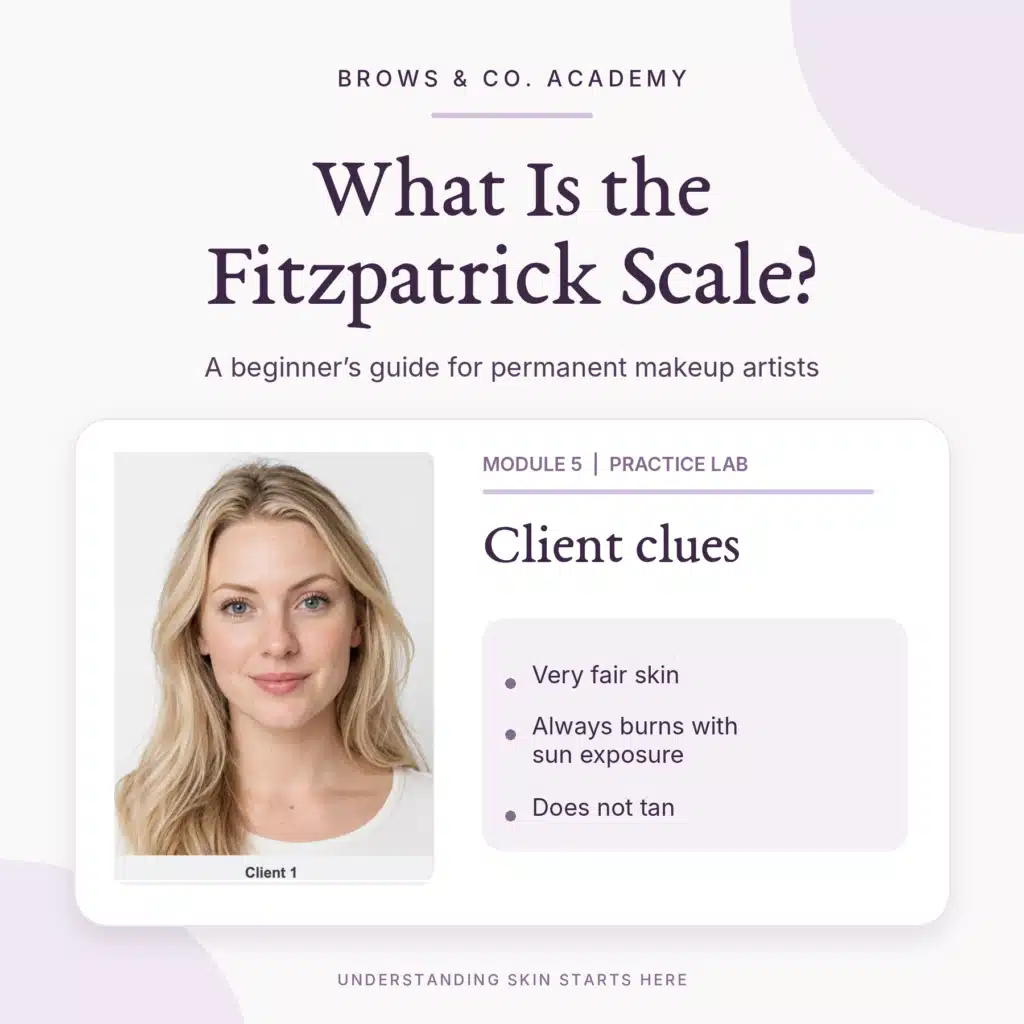
If you’re interested in becoming a permanent makeup artist, I have a question for you. How much do you really know about skin?
It’s easy to get excited about creating beautiful brows, choosing pigments, and learning techniques. But there’s something every aspiring PMU artist needs to understand before focusing on the artistry.
The skin you’re working on matters just as much as the brows you’re creating.
And that’s where the Fitzpatrick scale comes in.
What Is the Fitzpatrick Scale?
The Fitzpatrick scale is a classification system that describes how skin typically responds to ultraviolet (UV) exposure, particularly its tendency to burn or tan.
Developed by dermatologist Dr. Thomas Fitzpatrick, the system includes six skin phototypes, from Type I through Type VI.
Here’s something many beginners misunderstand.
The Fitzpatrick scale isn’t simply a chart of skin colors. You cannot accurately identify someone’s Fitzpatrick type just by looking at their complexion or knowing their ethnicity.
A person’s history of burning and tanning is an important part of understanding their skin phototype.
Why Does the Fitzpatrick Scale Matter in Permanent Makeup?
Permanent makeup involves placing pigment into the skin, so understanding skin characteristics is part of developing a strong foundation as an artist.
The Fitzpatrick scale introduces beginners to an important concept: two clients may have similar-looking complexions but different responses to sun exposure.
For aspiring brow artists, learning about Fitzpatrick skin types can help you:
- Ask more informed questions during client consultations.
- Understand the relationship between skin pigmentation and sun response.
- Recognize why visual appearance alone does not tell you everything about someone’s skin.
- Build a foundation for studying skin assessment, pigment selection, and permanent makeup procedures.
But remember, Fitzpatrick classification is only one part of a thorough skin assessment. It does not independently determine which permanent makeup technique, pigment, or procedure is appropriate for a client.
Skin condition, medical history, contraindications, and other individual factors matter too.
Can You Identify a Fitzpatrick Skin Type Just by Looking?
Not reliably.
And this is where learning becomes interesting.
Imagine two clients who appear to have similar skin tones. One reports burning easily after sun exposure, while the other rarely burns and develops a tan.
Would you automatically assign them the same Fitzpatrick type?
That’s the kind of question I want aspiring permanent makeup artists to begin asking.
Instead of memorizing a chart and moving on, I want you to understand why you’re making a particular assessment.
The Fitzpatrick scale also has limitations, particularly when used across diverse skin tones. That’s another reason thoughtful consultation and broader skin education are so important.
Let’s Put Your Knowledge to the Test
Inside my Brow Foundations course, I created an interactive activity called Guess the Fitzpatrick Type.
Students review different client scenarios, examine clues about skin characteristics and sun response, and practice identifying the appropriate Fitzpatrick classification.
It’s designed to encourage you to think through what you’re learning rather than simply memorize information.
And it’s only one of several interactive learning experiences inside the course.
Why I Created Brow Foundations
Over the years, I’ve spoken with many people who genuinely want to enter the permanent makeup industry.
One thing I kept hearing was that they wanted to learn, but the financial investment required for hands-on training wasn’t something they could manage right away.
I heard you.
That’s why I created Brow Foundations.
I wanted to offer an affordable starting point for people who are curious about permanent makeup and serious about learning the fundamentals.
For just $47, one time, Brow Foundations includes:
- 10 educational modules
- 37 lessons
- Interactive practice labs, including Fitzpatrick skin typing and brow mapping
- Client consultation learning activities
- A final assessment and certificate upon successful completion
- Lifetime access to revisit the material
This is foundational education, not a replacement for required licensing or supervised hands-on training.
My goal is to help you develop a stronger understanding of the industry before making your next investment.
Frequently Asked Questions About Fitzpatrick Skin Types
What does the Fitzpatrick scale measure?
The Fitzpatrick scale classifies skin into six phototypes based primarily on how it responds to ultraviolet exposure, including its tendency to burn and tan.
Is Fitzpatrick skin type the same as skin color?
No. Skin color may provide context, but Fitzpatrick classification focuses on skin’s response to sunlight. Appearance or ethnicity alone cannot reliably determine someone’s phototype.
Do permanent makeup artists need to understand Fitzpatrick skin types?
Understanding Fitzpatrick classification is a useful part of foundational PMU education. It helps artists develop their knowledge of skin assessment and client consultation, but it must be considered alongside other skin and health factors.
Can beginners learn permanent makeup online?
Yes. Online education can introduce beginners to skin anatomy, brow mapping, consultation, and other foundational concepts. Practical procedure training and compliance with local licensing requirements are separate responsibilities.
Ready to Start Learning?
If you’ve been thinking about becoming a permanent makeup artist but haven’t known where to begin, Brow Foundations was created with you in mind.
You don’t have to master everything today. You just need a place to start.
Explore Brow Foundations for $47
Kechia Taylor
Founder, Brows & Co. Academy
Permanent Makeup Artist & Educator | Odenton, Maryland